local shop POS → online marketplace with delivery · Retail tech · Point of sale · Q-Commerce / On-demand delivery
BarqiBazar
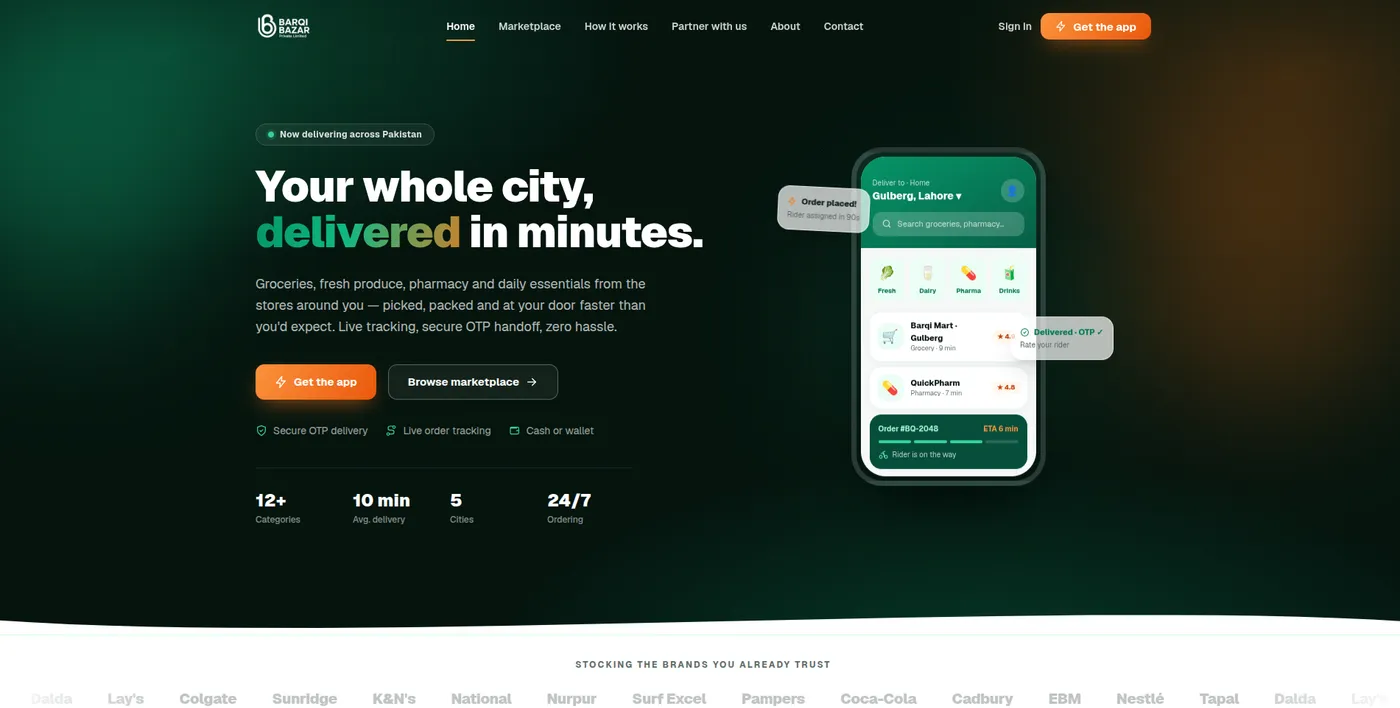
One platform that takes a local shop from an offline-first POS to an online store with its own delivery fleet — desktop POS, CouchDB catalog sync, customer + rider apps, and four operations portals.
Problem
Local shops had no affordable way to run their business and sell online at the same time. Off-the-shelf POS software was offline-only and disconnected from any marketplace, and delivery apps carried a separate, hand-typed catalog that drifted out of sync with what was actually on the shelf. There was no bridge from a shop with a cash counter to a store selling online across the city — no franchise → store → rider hierarchy, no automated way to assign deliveries, and no wallet or ledger to move money safely.
Solution
I built BarqiBazar as a franchise-based, multi-tenant commerce platform with three connected layers a merchant adopts in order. Layer 1 is an offline-first desktop POS that runs the whole shop — products, customers, suppliers, orders and profit & loss — working with or without internet and syncing to the cloud via CouchDB replication. Layer 2 is a catalog-sync pipeline: a dedicated NestJS ingestion service with per-store, runtime-configurable data sources pushes the merchant's real catalog live, so the shelf and the online storefront are one product truth — no re-typing, no drift. Layer 3 is the marketplace + delivery: shoppers browse city-scoped stores in a React Native app, each order becomes a delivery job auto-matched to nearby riders with a secure OTP handoff, and an in-house wallet + cash-on-delivery ledger settles money to store, rider and franchise with concurrency-safe, authorization-hardened guards. Independent NestJS microservices — identity/IAM, core operations, orders + bidding, wallet/ledger, catalog ingestion and notifications — each own their PostgreSQL database via Prisma and talk over a RabbitMQ event bus behind a gateway, with staff running the whole network from four role-based portals.
Key features
- Offline-first desktop POS — products, customers, suppliers, orders and profit & loss, working with or without internet
- CouchDB cloud replication — the POS syncs safely the moment the connection returns
- Catalog-sync pipeline with per-store, runtime-configurable data sources — the shelf and the storefront are one product truth
- Franchise → store → rider hierarchy, city-scoped on the server
- Delivery-bidding marketplace that auto-matches orders to nearby riders, with secure OTP handoff
- In-house wallet + cash-on-delivery ledger with hardened, concurrency-safe settlement
- Four role-based portals (seller/store, franchise, contract, admin) + IAM console
- Customer & rider React Native apps sharing one API; order-scoped product & rider reviews
Technology
Results
- A true on-ramp from local to online — the same catalog that runs the counter becomes the online storefront, with no re-typing or drift
- Paper and offline tills replaced by a real system of record (inventory, customers, suppliers, P&L) that works with or without internet
- Manual dispatch replaced by an automated, city-by-city delivery marketplace
- Disconnected tools replaced by one platform spanning POS, online store, delivery, payments and operations
Want something like BarqiBazar?
Usman Arif builds production web, mobile and POS systems for teams worldwide.
usman.professional01@gmail.com →